



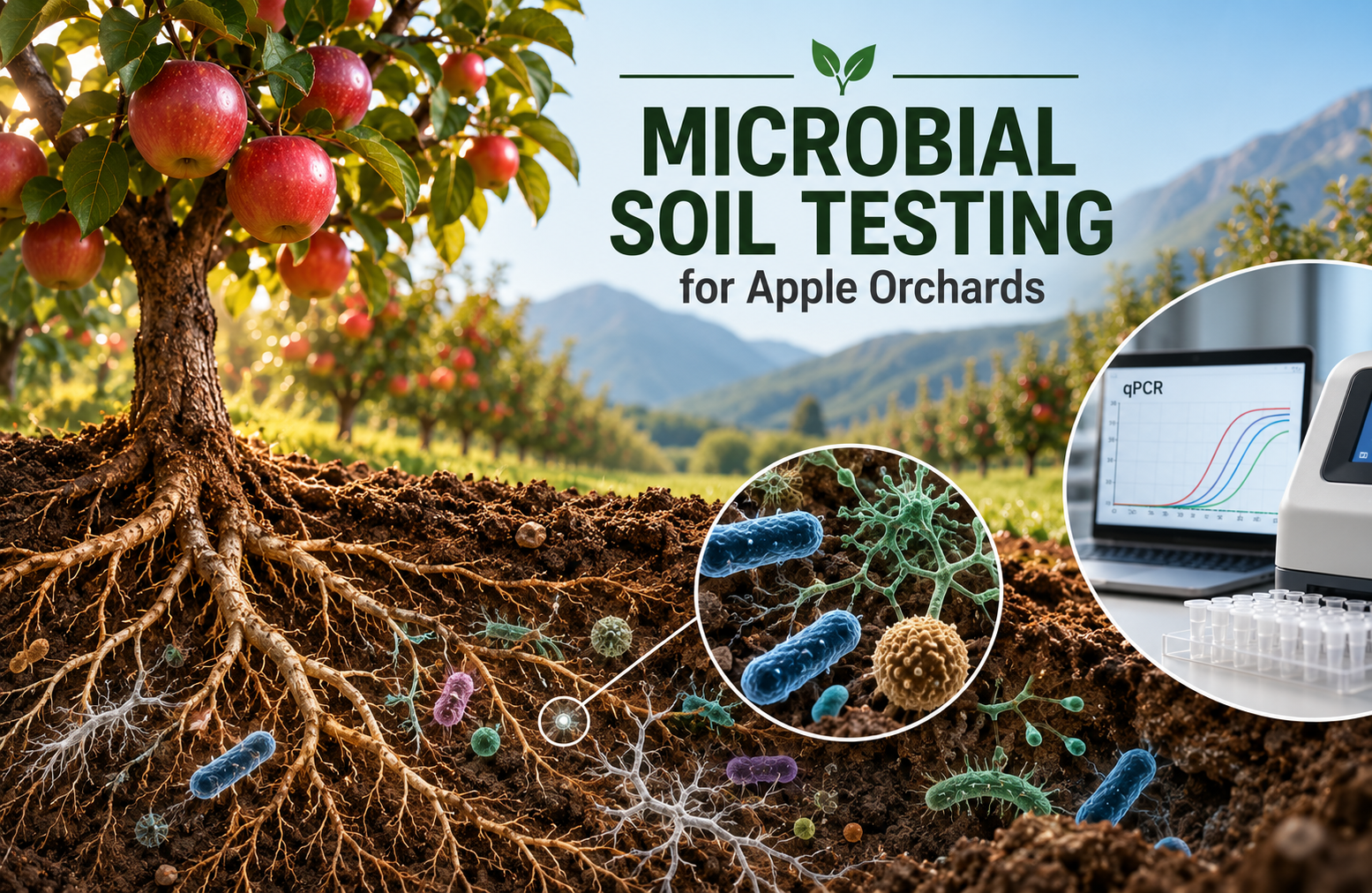
A soil test can tell you how much phosphorus is present. But can it tell you how effectively the living soil system is helping make nutrients available to your apple trees?
For decades, apple growers have relied on soil testing to understand the chemical condition of their orchards. Soil pH, electrical conductivity, organic carbon, nitrogen, phosphorus, potassium and micronutrients are important indicators that help guide fertiliser application and soil management.
But soil is more than a collection of minerals and nutrients.
Beneath every apple tree exists a complex living ecosystem inhabited by bacteria, fungi, archaea and other microorganisms. These organisms participate in nutrient cycling, organic matter decomposition, soil aggregation and interactions with plant roots.
Some microorganisms support plant growth. Others are associated with root diseases. Many perform functions that are still being investigated by soil scientists.
Chemical soil testing tells us an important part of the story. Microbial soil testing reveals another.
With advances in molecular biology and soil analysis, growers can now begin to investigate this biological dimension of soil health alongside conventional chemical testing.
For Kashmir’s apple orchards, where long-term productivity depends on healthy roots, balanced nutrition and sustainable soil management, this represents an important opportunity.
Soil is a living ecosystem, not just a nutrient reservoir
When growers think about soil fertility, the first things that often come to mind are nitrogen, phosphorus, potassium and organic matter. These are important, but they do not explain every process taking place around the roots.
Soil microorganisms are involved in the transformation and movement of nutrients. They break down organic materials, release nutrients through mineralisation, influence nutrient availability and interact with roots in ways that can affect plant development.
The region immediately surrounding plant roots is called the rhizosphere. It is one of the most biologically active parts of the soil because roots release sugars, organic acids and other compounds that influence microbial activity.
In return, microorganisms can influence nutrient availability, root growth, soil structure and plant responses to environmental stress.
Two orchards may have similar soil pH and nutrient concentrations but differ in their microbial communities and biological processes.
That does not automatically mean one orchard will produce better fruit than the other. It does mean that chemical measurements alone cannot describe every aspect of the soil environment.
What conventional chemical soil testing tells us
Chemical soil testing remains the foundation of scientific soil management. A conventional soil analysis can help determine whether the soil is acidic or alkaline, whether soluble salts are excessive, how much organic carbon is present and whether particular nutrients are deficient or excessive.
In Kashmir’s apple orchards, these measurements are particularly useful for managing nutrient availability, fertiliser programmes and long-term soil fertility.
For example, soil pH can strongly influence phosphorus and micronutrient availability. Organic carbon can provide information about the soil’s organic matter status, while available phosphorus and potassium measurements can help guide nutrient management. However, chemical soil analysis generally does not identify which microorganisms are present, how microbial communities are structured or which biological functions may be represented.
A soil may contain measurable phosphorus, but its availability to the plant also depends on soil chemistry, roots and biological processes. Similarly, organic carbon provides useful information about soil organic matter, but it does not directly reveal the composition or activity of the microbial community. This is why microbial testing should complement chemical testing—not replace it.
What is microbial soil testing?
Microbial soil testing evaluates selected microorganisms or biological characteristics of soil to understand its biological condition. Depending on the laboratory method, the analysis may examine microbial biomass, biological activity, particular beneficial microorganisms, potential soilborne pathogens or the genetic material of targeted organisms.
Soil microorganisms perform several functions that are important for fruit production. They contribute to the decomposition of organic matter, participate in nutrient transformations, influence soil aggregation and interact with plant roots. Certain microbial strains may also support plant growth or suppress particular pathogens under suitable conditions.
However, not all microorganisms perform the same functions, and the presence of a particular microbial group does not automatically mean that it is beneficial or harmful in every orchard. Results must be interpreted according to the test method, soil conditions, crop history and observed orchard symptoms.
Microbial soil testing therefore helps answer questions that conventional chemical analysis cannot answer on its own: Which biological indicators are present? Can selected microorganisms be detected? Is further investigation of the orchard’s root-zone biology warranted?
How qPCR-Based Testing Adds Precision to Microbial Soil Analysis
One of the important molecular approaches used in microbial analysis is quantitative Polymerase Chain Reaction (qPCR). Unlike a conventional soil test that measures chemical properties, qPCR is designed to detect and quantify specific genetic targets in a sample.
The process generally involves extracting DNA from soil, using specially designed primers to target a selected DNA sequence, and amplifying that sequence while monitoring a fluorescent signal. The resulting measurements can help estimate the amount of the target genetic material in the sample when the assay is appropriately calibrated.
In practical terms, qPCR can be used to investigate the presence or relative quantity of selected microorganisms, including particular soilborne pathogens or beneficial microbial targets, provided validated assays are available for them. For apple orchards, this approach may be useful when investigating specific root-zone biological concerns that cannot be resolved through chemical soil analysis alone.
For example, where a validated assay exists, targeted qPCR may help investigate selected organisms associated with root diseases. The findings can help an agronomist decide whether further assessment is needed and interpret the results alongside root symptoms, drainage, soil moisture, orchard history and other diagnostic evidence.
An important distinction is that qPCR detects genetic material, not necessarily living or active microorganisms. DNA may remain detectable after an organism has died. Therefore, a positive result does not automatically establish that a pathogen is active, that it is causing disease or that treatment is necessary. Likewise, a negative result does not always rule out an organism, because detection depends on sampling quality, DNA extraction, assay sensitivity and the distribution of the target in soil.
qPCR is also different from broad microbial DNA sequencing. Targeted qPCR is useful when the laboratory wants to look for a particular genetic target, whereas sequencing can provide a broader view of microbial community composition, depending on the sequencing method. Neither approach, by itself, fully establishes what every microorganism is doing in the soil.
The greatest value comes from choosing the appropriate method for the question being investigated and interpreting the results within the wider context of orchard health.
Why microbial soil testing matters for apple growers
Apple trees are perennial crops. Unlike annual crops that are replanted each season, an apple tree depends on the same root-zone environment for many years.
Over time, soil management practices, irrigation, fertilisation, organic matter additions, compaction, drainage and crop-protection decisions can influence the biological conditions around the roots.
For this reason, understanding soil biology can be particularly valuable in established orchards, high-density plantations and sites being prepared for replanting.
Understanding nutrient cycling beyond fertiliser application
A fertiliser programme supplies nutrients, but the movement and transformation of nutrients in soil involve physical, chemical and biological processes. Microorganisms participate in the decomposition of organic matter and the conversion of nutrients between different forms. Some bacteria and fungi can solubilise certain forms of phosphorus under suitable conditions. Other microorganisms contribute to nitrogen transformations or organic nutrient mineralisation.
For apple growers, this means microbial analysis may provide additional insight into the biological processes associated with nutrient availability. But the presence of a phosphorus-solubilising microorganism does not prove that an orchard has sufficient plant-available phosphorus. Soil phosphorus testing, root activity, moisture and other factors remain essential.
The practical advantage is a more complete understanding of the soil system, rather than relying on nutrient concentrations alone.
Understanding the biology around apple roots
Healthy root development is fundamental to apple productivity. Roots absorb water and nutrients, support the tree physically and interact with microorganisms in the surrounding soil. Beneficial microorganisms may contribute to nutrient mobilisation, root development and biological competition with certain pathogens.
For example, some species and strains belonging to Bacillus and Trichoderma have been studied for plant-growth-promoting and biological-control properties. Their effectiveness, however, depends on the specific strain, soil conditions, host plant and surrounding microbial community.
Finding a potentially beneficial organism in a soil sample should therefore be treated as an indicator of biological potential, not a guarantee of improved tree growth or disease suppression.
Investigating soil-associated disease risks
Apple growers are familiar with diseases affecting leaves and fruit, but important problems can also develop below ground. Poor drainage, waterlogging, root damage and soilborne pathogens can compromise root function and affect tree vigour. Organisms associated with root diseases, including certain Phytophthora and Pythium species, can be important in orchard health investigations. Some plant-parasitic nematodes can also damage roots or contribute to declining tree performance.
Targeted microbial or molecular testing can help identify selected organisms associated with these problems. However, detecting a pathogen-associated marker does not necessarily mean disease is occurring or will develop. Disease depends on factors such as pathogen identity, abundance, host susceptibility and environmental conditions.
A positive result should guide further investigation, not automatically trigger pesticide application.
Understanding soil biology in high-density orchards
High-density apple orchards, particularly those established on dwarfing rootstocks such as M9, require careful management of water, nutrients and root-zone conditions. Because these rootstocks generally have relatively restricted root systems compared with vigorous seedling-rootstock trees, maintaining a favourable soil environment is especially important.
Microbial testing may help growers build a more complete picture of the root-zone environment when combined with chemical soil analysis, irrigation information and field observations. It should not be used to infer root health or fertiliser requirements from a single biological score.
What microorganisms and biomarkers can be investigated?
Not all microbial soil tests measure the same things. Some identify broad microbial groups, while others focus on particular organisms or genetic markers.
The following examples illustrate the types of biological information that may be relevant to apple orchards.
| Microorganism or marker group | Why it may be relevant |
|---|---|
| Bacillus species, including B. subtilis | Certain strains are associated with plant-growth promotion and biological antagonism |
| Trichoderma species, including T. harzianum | Certain strains have been studied for root interactions and biological control |
| Phosphorus-solubilisation-associated markers | May indicate genetic potential related to phosphorus mobilisation |
| Phytophthora species | Some species are associated with root and crown diseases in apple |
| Pythium species | Certain species are associated with root disease under conducive conditions |
| Pratylenchus species | Plant-parasitic nematodes that can affect roots |
The actual organisms and markers reported depend on the laboratory’s validated testing panel. Their detection must be interpreted in the context of the specific assay, rather than assuming that every marker directly measures a beneficial or harmful function.
Can two orchards with similar chemical soil tests behave differently?
Consider two hypothetical apple orchards with comparable soil pH, organic carbon and available phosphorus. In Orchard A, soil management has maintained good drainage, suitable organic matter inputs and favourable conditions for root growth. In Orchard B, repeated machinery movement has contributed to compaction, drainage is poor and the trees have shown uneven growth. The chemical soil results might appear similar, but the root-zone environments are different.
Microbial analysis may reveal differences in the communities or biological markers present in the two soils. Combined with physical soil assessment and orchard observations, these differences could help guide further investigation. It would be incorrect, however, to conclude that a particular microbial pattern alone explains the difference in tree performance.
The strength of microbial testing is that it adds another layer of evidence to an already complex agronomic picture.
How should growers use microbial soil-test results?
The most useful microbial soil test is one that helps a grower ask better management questions. If testing identifies unusual biological patterns, the next step may be to investigate organic matter management, irrigation, drainage, compaction, root condition or orchard history. If a potentially harmful organism is detected, the result may justify targeted root inspection or confirmatory testing.
If beneficial microbial markers are identified, growers can use that information to understand the biological characteristics of the soil, but should not assume that purchasing a microbial inoculant or changing fertiliser rates will automatically improve production.
For perennial crops such as apple, repeated sampling using consistent methods may be more informative than a single isolated result, particularly when measurements are compared at similar seasonal stages.
Chemical testing and microbial testing: two complementary perspectives
The most useful way to understand these approaches is to see them as different dimensions of soil intelligence.
| Chemical soil testing | Microbial soil testing |
|---|---|
| Measures soil pH and EC | Investigates selected microorganisms or biological indicators |
| Measures available nutrients | May reveal nutrient-cycling-associated organisms or markers |
| Measures organic carbon | Adds information about biological community characteristics |
| Supports fertiliser and amendment planning | Supports investigation of biological soil conditions |
| Identifies chemical limitations | May identify selected beneficial or pathogen-associated markers |
Neither test alone provides a complete explanation of orchard performance.
A complete soil-health assessment may also require physical soil measurements, root observations, irrigation assessment, plant tissue analysis and orchard management history.
The future of soil management lies in combining these sources of information rather than treating any one test as the complete answer.
Orchardly: Bringing microbial soil intelligence to Kashmir
For years, conventional soil testing has helped growers understand the chemical composition of their orchard soils. Orchardly is now taking an important step towards expanding that understanding.
With the establishment of the region’s first dedicated microbial soil-testing laboratory, Orchardly is introducing a new dimension of soil intelligence for apple growers in Kashmir.
The objective is to move beyond viewing soil only through pH, nutrients and organic carbon and begin examining the biological environment in which apple roots grow.
By bringing microbial analysis together with conventional chemical soil testing, Orchardly aims to help growers understand not just what their soil contains, but also the microorganisms and biological indicators that may influence nutrient cycling, root-zone interactions and soil health.
This approach fits into Orchardly’s broader vision of precision horticulture, where soil information is considered alongside weather, crop stage, orchard conditions and agronomic expertise.
Rather than making fertiliser or crop-protection decisions from one isolated measurement, growers can begin to build a more comprehensive understanding of their orchard.
Microbial soil testing is not a substitute for soil chemistry, field scouting or laboratory diagnosis of plant diseases. It is an additional tool for understanding a complex living system.
To book your microbial soil test, download Orchardly App
Frequently Asked Questions
What is microbial soil testing?
Microbial soil testing examines microorganisms or biological indicators in soil. Depending on the method, it may identify selected bacteria, fungi, pathogens, microbial groups or genetic markers associated with biological functions.
How is microbial soil testing different from chemical soil testing?
Chemical testing measures properties such as pH, EC, organic carbon and nutrient availability. Microbial testing examines biological characteristics, including selected microorganisms or markers. The two approaches complement one another.
Why is microbial soil testing important for apple orchards?
Apple trees depend on the same root-zone environment for many years. Microbial testing can provide additional information about the soil ecosystem, nutrient-cycling potential and selected organisms associated with root health or disease risk.
Can microbial testing identify nutrient deficiencies?
Not directly. Microbial testing may identify organisms or markers associated with nutrient cycling, but chemical soil testing and, where appropriate, leaf analysis remain necessary for evaluating nutrient status.
Can microbial soil testing detect root diseases?
Some targeted microbial tests can detect organisms associated with root diseases. However, detection alone does not confirm an active disease or predict an outbreak. Symptoms, root examination and appropriate confirmatory tests may be needed.
Does the presence of beneficial bacteria mean the soil is healthy?
Not necessarily. Soil health depends on multiple physical, chemical and biological factors. The presence of a beneficial microorganism does not establish its activity or guarantee improved plant growth.
Can microbial soil testing help reduce fertiliser use?
It may contribute to better-informed nutrient management when combined with conventional soil testing and orchard observations. However, fertiliser reductions should not be based on microbial results alone.
Is microbial soil testing useful for high-density apple orchards?
Yes, it can add information about biological soil conditions in high-density orchards, where careful management of root-zone moisture, nutrition and soil conditions is important.
How often should microbial soil testing be done?
There is no universal testing frequency for every orchard. The appropriate interval depends on the objective, testing method, management changes and seasonal variability. For comparisons, sampling at similar times and using consistent methods is important.
Can microbial soil testing replace conventional soil testing?
No. Chemical, biological and physical soil assessments provide different information. Microbial testing should be used as an additional layer of soil intelligence.
How can growers improve soil microbial health?
Maintaining suitable organic matter, avoiding unnecessary compaction, managing irrigation and drainage, using appropriate groundcovers and following balanced nutrient-management practices can help support soil biological functioning.
Where can apple growers access microbial soil testing in Kashmir?
Orchardly is establishing dedicated microbial soil-testing capabilities for growers in the region, complementing its conventional soil-testing and orchard-intelligence services. Growers can contact Orchardly to learn about available tests, sample collection and reporting.