



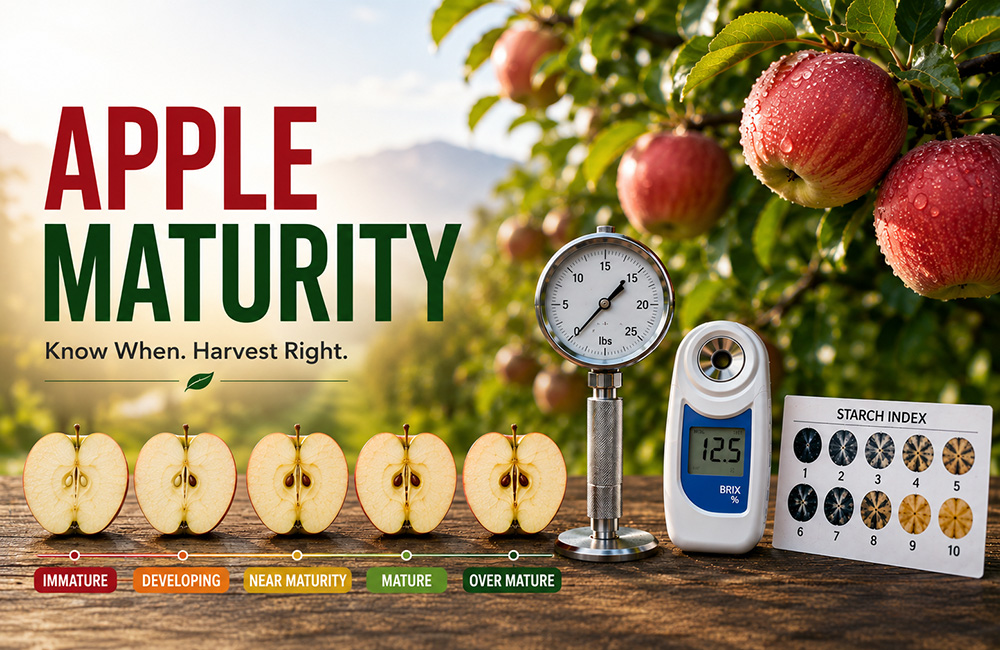
An apple can look ready to harvest and still not be ready to pick.
Every harvest season, growers face one of the most important decisions in the orchard: when is the fruit actually mature enough to harvest?
The answer cannot always be found on the calendar—or even by looking at the fruit.
A red blush may suggest that an apple is ready, but colour can develop ahead of internal maturity. A high °Brix reading can indicate good sugar levels while significant starch may still remain. Fruit may feel firm enough for the market but be too mature—or too immature—for long-term storage.
Harvesting too early can mean poor flavour, inadequate colour, excessive starch and underdeveloped eating quality. Harvesting too late can mean declining firmness, greater bruising, shorter storage life and increased risk of physiological disorders.
The decision becomes even more complex in modern orchards. Different cultivars and strains can mature at different rates, while full bloom, accumulated heat, elevation, rootstock, crop load, water availability and orchard microclimate can shift the harvest window from one block to another—and from one season to the next.
So, when is an apple truly ready?
There is no single answer.
A reliable harvest decision comes from bringing several signals together:
Variety + Full Bloom + Weather + Heat Accumulation + Orchard Conditions + Fruit Maturity Testing + Storage Objective
This Orchardly Academy guide explores the science behind apple maturity—from physiological changes inside the fruit to practical maturity tests such as starch index, firmness, °Brix, acidity, colour and IAD—and explains how weather-aware, data-driven maturity forecasting can help growers plan a better harvest window.
Because the goal is not simply to pick apples on time.
It is to pick the right fruit, at the right maturity, for the right destination.
What is apple maturity?
Apple maturity is the stage at which fruit has developed sufficiently for its intended purpose.
But there is an important distinction:
Maturity is not necessarily the same thing as eating ripeness.
An apple harvested for long-term storage may be considered commercially mature even though it has not yet reached its best eating quality.
An apple intended for immediate consumption can generally be allowed to progress further toward eating maturity.
This gives us three useful concepts.
1. Physiological maturity
Physiological maturity refers to the developmental state at which the fruit has progressed sufficiently through its biological development and has the capacity to continue its ripening processes after harvest.
During this period, several changes occur:
- chlorophyll in the peel declines
- starch reserves are progressively converted into soluble sugars
- ethylene production begins to increase in climacteric cultivars
- respiration changes
- cell-wall structure begins to change
- firmness gradually declines
- flavour and aroma compounds develop
The exact sequence and rate of these changes depend heavily on cultivar and growing conditions.
2. Commercial or harvest maturity
Commercial maturity is more practical.
It asks: Is this fruit ready to be harvested for the market it is intended for?
A commercial harvest decision considers firmness, starch conversion, soluble solids, colour, flavour, storage destination, transport requirements, expected storage duration & cultivar-specific standards
3. Eating maturity
Eating maturity is the point at which consumers perceive the apple to have the desired sweetness, acidity, aroma, crispness, juiciness, texture & flavour complexity
These three stages do not always occur simultaneously.
That is particularly important for apples intended for cold storage or controlled-atmosphere (CA) storage.
Why you should not harvest apples by calendar date alone
One of the most common harvest practices is to look at last year’s harvest date and use it as this year’s target.
For example:
“We harvested this Gala on September 5 last year, so we should harvest it around September 5 this year.”
Historical dates are useful—but they should be treated as reference points, not fixed instructions.
Apple maturity is affected by the growing season.
University extension guidance notes that harvest timing varies with bloom date, weather, cultivar and the intended use of the fruit.
Important sources of variation include: full bloom date, temperature, accumulated heat, cool-night conditions, rainfall, water availability, crop load, rootstock, thinning, elevation, aspect, canopy conditions, variety and strain, orchard microclimate, intended storage period.
A cultivar may mature at approximately the same physiological stage each year while reaching that stage on a different calendar date.
That distinction is fundamental.
The fruit follows biology. The calendar only records it.
Apple maturity is variety-specific
Apples are not interchangeable.
Different cultivars have different: developmental rates, starch conversion patterns, firmness retention, ethylene behaviour, respiration characteristics, colour development, sugar accumulation patterns, acidity profiles, storage potential, & susceptibility to physiological disorders.
Even strains within the same cultivar can differ.
This is especially relevant for modern commercial apple production, where growers may have several Gala strains planted within the same farm.
Early-maturing apples
Examples include: Gala Galaxy, Devil Gala, SchniCo & SchniCo Red, Dark Baron, Gala Memastar, Gala One, Gala Dark Enn and others
These cultivars and strains generally enter their harvest window earlier than late-season cultivars.
The maturity window can also move considerably between strains.
A grower should therefore avoid treating “Gala” as a single maturity date.
Mid-season apples
Examples include: Royal Delicious, Red Delicious strains, Mema, Super Chief, Oregon Spur, Ambrosia
These generally occupy an intermediate harvest period, although the actual window depends heavily on region and season.
Late-season apples
Examples include: Golden Delicious, Fuji, Granny Smith
These generally have longer development periods and may accumulate considerably more thermal time before reaching their target harvest stage.
Very late cultivars
Examples include:
- Pink Lady / Cripps Pink
- Braeburn
Late-season cultivars can be particularly sensitive to the final weeks of temperature conditions.
Cool nights, heat accumulation and late-season weather can influence colour development, firmness and maturity progression.
Modern high-value cultivars
Cultivars such as:
- Honeycrisp
- Cosmic Crisp
require particularly careful maturity management because harvest timing strongly influences eating quality and postharvest performance.
The lesson is simple:
There is no universal apple maturity number that applies to every cultivar.
Variety-specific maturity: why Gala, Red Delicious and Fuji behave differently
Gala
Gala is an important example of why harvest timing must be precise.
Gala strains can mature rapidly once the harvest window begins.
Important indicators include:
- starch conversion
- background colour
- firmness
- soluble solids
- over-colour
- flavour
Because some Gala strains can move quickly from commercially desirable maturity toward over-maturity, frequent sampling close to harvest becomes important.
Red Delicious
Red Delicious presents a different challenge.
Its strong red colour can create a misleading visual signal.
A grower may delay harvest because the fruit is waiting for additional colour even though internal maturity is already advancing.
Therefore:
Colour development and internal maturity should be evaluated separately.
Fuji
Fuji is generally a later-season cultivar with strong storage potential.
Its external appearance may not always provide a precise indication of internal maturity.
Important considerations include:
- starch pattern
- firmness
- soluble solids
- flavour
- background colour
- storage destination
The objective is to harvest fruit that has adequate maturity without allowing it to move too far into the ripening process before storage.
Golden Delicious
Golden Delicious can show substantial changes in background colour as maturity progresses.
Starch and firmness can be useful in determining the harvest window, especially when fruit is being prepared for storage.
Granny Smith
Granny Smith demonstrates particularly well why colour cannot be treated as a universal maturity index.
The fruit may remain green even as internal physiological maturity advances.
For such cultivars, growers should pay closer attention to:
- starch
- firmness
- soluble solids
- acidity
- other cultivar-specific maturity indicators
Honeycrisp
Honeycrisp deserves special attention because firmness may not decline in the same way as some other cultivars during maturation.
The UC Davis Postharvest Research and Extension Center notes that firmness can be a poor maturity indicator for Honeycrisp and recommends considering starch alongside other quality indicators.
This is a useful reminder:
A maturity test is only meaningful when interpreted in the context of the cultivar.
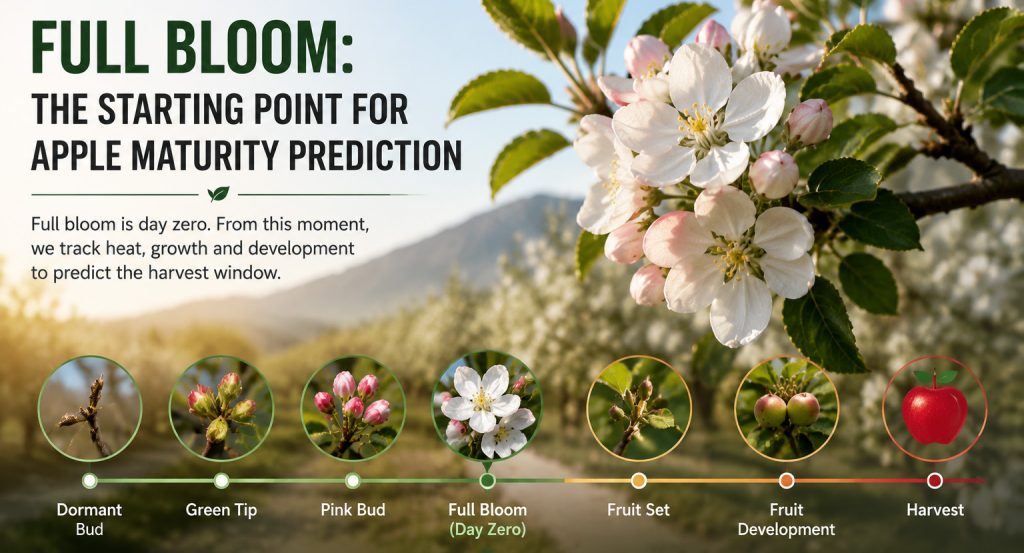
Full bloom: the starting point for apple maturity prediction
One of the most useful reference points in apple phenology is Full Bloom.
Once full bloom is established, growers can calculate:
Days After Full Bloom (DAFB)
DAFB is simply the number of days that have elapsed since full bloom.
For example:
If full bloom occurred on April 25 and harvest occurred on September 5, the orchard has accumulated approximately 133 DAFB.
DAFB can be extremely useful for historical comparison and maturity modelling.
But it has a limitation:
One hundred and thirty days in a cool season are not necessarily equivalent to 130 days in a hot season.
That is why thermal-time models are useful.
Does apple maturity occur at the same time every year?
No. Research and extension resources emphasize that apple ripening varies between seasons, particularly because bloom date and growing-season weather influence maturity.
Consider two hypothetical seasons.
Season A: Early bloom, Warm spring, Rapid heat accumulation, Warm summer, Moderate crop load
The orchard may reach its harvest maturity earlier.
Season B: Late bloom, Cool spring, Slow early development, Lower heat accumulation, Cooler summer
The same cultivar may require more calendar days before reaching the same physiological stage.
Therefore: Harvest date should be predicted from biological development, not copied from last year’s calendar.
What are GDD and GDH?
Growing Degree Days (GDD)
Growing Degree Days measure accumulated temperature above a defined base temperature.
A simplified calculation is:
GDD = Σ (Tavg − Tbase)
where Tavg = average temperature, Tbase = crop or model-specific base temperature
The exact calculation can vary depending on the model.
GDD is useful because it converts temperature into a measure of accumulated developmental progress.
Instead of saying: “It has been 120 days.”
We can ask: “How much thermal time has the orchard accumulated?”
Growing Degree Hours (GDH)
GDH takes the concept further by looking at temperature accumulation on an hourly basis. This can be particularly useful in mountain horticulture.
A Himalayan orchard may experience hot afternoons, cool evenings, cold nights, large day-night temperature differences. Two orchards can therefore have similar daily averages but very different hourly temperature patterns. GDH can capture some of that variation.
For orchard intelligence systems, hourly weather data can therefore provide valuable information that a simple daily calendar cannot.
Why early-season weather matters
Growers often focus on weather during the final two weeks before harvest.
That is important—but it is not the whole story.
The developmental trajectory of the fruit is influenced by conditions throughout the season.
Early-season temperature affects cell division, fruit growth, developmental rate, subsequent thermal accumulation & eventual maturity timing.
Therefore, an orchard intelligence system should not only ask: “What is the temperature today?”
It should ask: “What has this fruit experienced throughout the season?”
How temperature affects apple maturity
Temperature influences several physiological processes.
Warmer conditions: Higher temperatures can increase metabolic activity and accelerate development. But excessive heat can create problems. High temperatures can contribute to increased respiration, water stress, sunburn, reduced colour development in some cultivars, accelerated quality deterioration, greater postharvest risk.
Cooler conditions: Cool conditions can slow development. However, cool nights close to harvest can favour red colour development in many blushed cultivars.
This is why day temperature and night temperature should not be treated as identical signals.
The importance of night temperature
One of the most interesting aspects of apple maturity is the role of the night-time environment.
Many red cultivars develop better colour under suitable cool-night conditions.
Colour development is influenced by anthocyanin synthesis, which is sensitive to temperature and light.
This creates an important distinction:
Colour is an environmental response as well as a maturity signal.
A fruit can therefore become highly coloured without having reached the ideal internal maturity for its destination.
Water stress and apple maturity
Water availability also influences fruit development and quality. Moderate water limitation can alter soluble solids concentration, fruit growth, canopy behaviour & colour development.
Severe or prolonged stress can negatively affect fruit size, calcium movement, firmness, storage quality & physiological disorder risk.
Therefore, maturity models should be interpreted alongside the orchard’s water and stress history.
Heat stress near harvest
Extreme heat close to harvest can create a difficult situation. The fruit may show rapid changes in colour or metabolism while internal quality does not necessarily progress in the same proportion.
Heat stress can also increase respiration, water demand, sunburn risk & physiological stress.
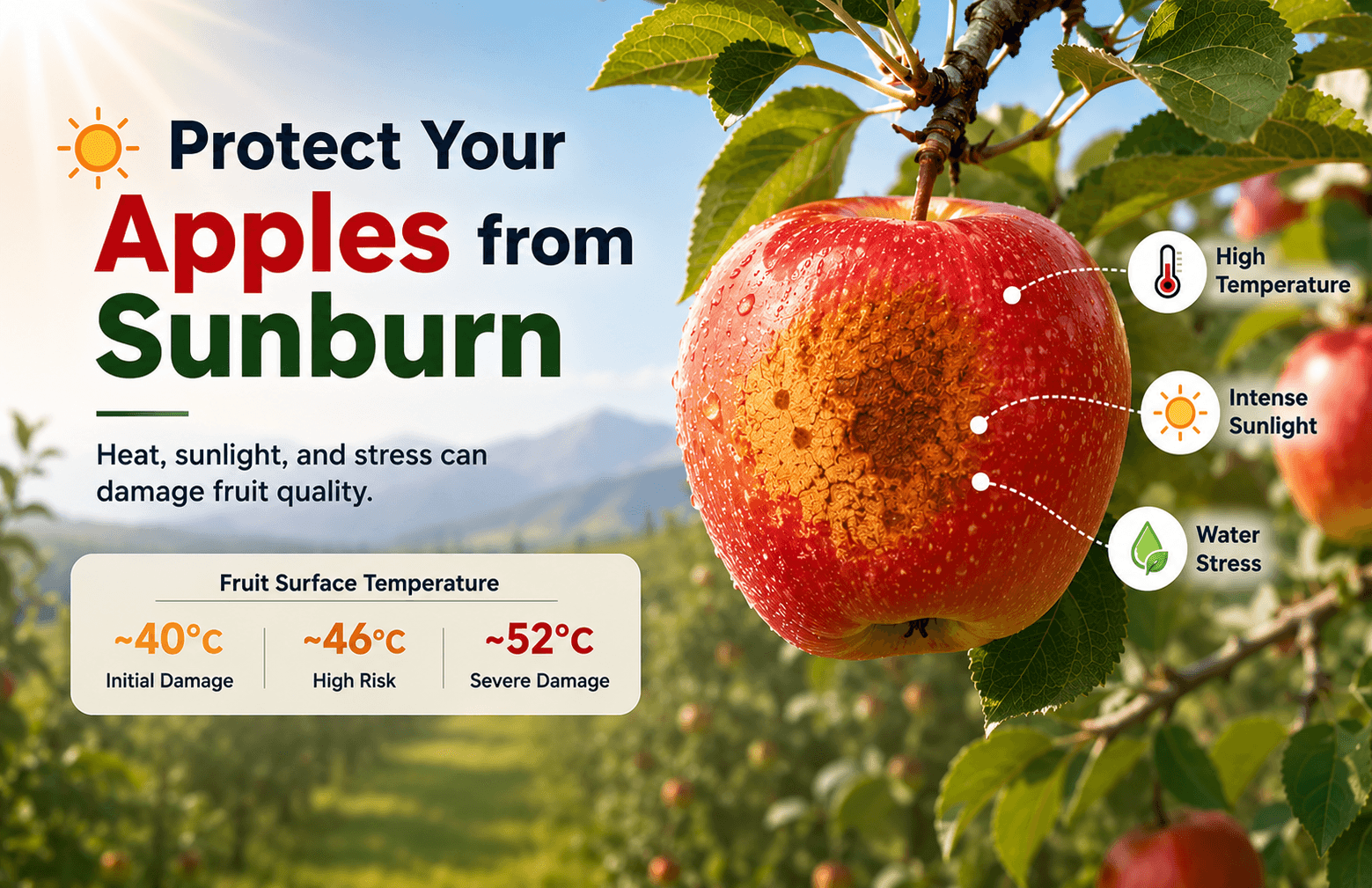
This is one reason weather-based maturity models should incorporate stress information, not merely accumulated temperature.
The major apple maturity indexes
Professional harvest decisions rely on multiple maturity indicators.
The University of Maryland Extension specifically recommends using several maturity indices because no single index explains true maturity across all cultivars, years and orchard blocks.
The major indicators include Starch index, Firmness, Soluble solids / Brix, Titratable acidity, Background colour, Over-colour, IAD / DA index, Ethylene, Respiration, Dry matter, Flavour & Composite indices such as the Streif Index.
1. Starch Index: one of the most important maturity tests
Starch conversion is one of the most widely used indicators of apple maturity. Immature apples contain substantial quantities of starch.
As maturation progresses: Starch → Sugars
An iodine-based test makes remaining starch visible. When iodine reacts with starch, the affected areas become dark. As starch disappears, the staining pattern changes. The resulting pattern is compared with a cultivar-appropriate starch chart.
Research literature continues to describe starch pattern testing as a major reference method for assessing apple maturity.
Why starch matters
Starch can provide a more useful indication of internal maturity than colour alone.
This is particularly important when fruit colour is misleading, weather has accelerated blush, the cultivar has weak colour development & storage decisions are being made.
Important limitation
Starch targets are cultivar- and programme-specific.
There is no single starch value that should automatically trigger harvest for every apple.
2. Fruit firmness
Firmness measures the force required to penetrate the fruit flesh. It is generally measured using a penetrometer, pressure tester or texture analyser.
Firmness is important because it influences handling, bruising resistance, consumer perception, storage potential & texture.
As apples mature and ripen, cell-wall and middle-lamella changes contribute to softening. However, firmness does not behave identically across cultivars. Honeycrisp is an excellent example where firmness alone is not a reliable maturity indicator.
Therefore: Firmness should be interpreted alongside starch and other maturity measurements.
3. Soluble solids and Brix
A refractometer can measure soluble solids, commonly reported as °Brix.
Soluble solids are strongly influenced by sugars and other soluble compounds.
Brix is useful for understanding sweetness potential, fruit quality & flavour development.
But Brix is not a complete maturity test. An apple can have acceptable Brix while still having excessive starch, inadequate firmness, insufficient colour or an unsuitable storage maturity
Therefore: High Brix ≠ automatically mature apple.
4. Titratable acidity
Acidity is an important component of apple flavour.
The relationship between: Sugar + Acidity + Aroma + Texture largely determines the consumer’s perception of eating quality. Two apples with identical Brix can taste completely different if their acidity differs.
For premium markets, sugar-acid balance can therefore be more informative than sugar alone.
5. Background colour
Background colour refers to the underlying colour of the peel as green gradually changes toward yellow or lighter tones.
For some cultivars, background colour can be a useful maturity indicator. However, its usefulness is cultivar-specific.
For example, Granny Smith’s green appearance cannot be interpreted using the same colour criteria as a yellowing cultivar.
6. Red colour and blush
Red blush is visually important for many commercial cultivars. But it is primarily a quality and appearance indicator, not a standalone maturity certificate. Blush can be affected by sunlight, temperature, canopy exposure, cultivar genetics & anthocyanin synthesis.
Therefore: A red apple is not necessarily a mature apple.
This is particularly important for Red Delicious and other strongly coloured cultivars.
7. IAD / DA index
The Index of Absorbance Difference (IAD), often measured with a DA-meter, provides a non-destructive optical measurement related to changes in chlorophyll.
As fruit matures: Chlorophyll decreases → IAD generally decreases
The University of Maryland notes that DA values can be useful when combined with other maturity measurements, but that thresholds vary by cultivar, orchard and year and should not be used independently.
This makes IAD especially interesting for precision horticulture because it allows repeated measurements without destroying every sampled apple.
8. Ethylene
Apple is a climacteric fruit. During ripening, ethylene production can increase significantly. Ethylene is involved in the regulation of several ripening processes, including starch degradation, colour changes, aroma development, softening & other physiological transitions. However, ethylene behaviour is strongly cultivar-dependent.
The onset and rate of ethylene production can therefore be useful in advanced maturity programmes but should not be treated as a universal harvest trigger.
9. Respiration
Respiration is the process through which harvested fruit consumes stored substrates and produces energy, CO₂ and heat.
As respiration increases, stored reserves are consumed more rapidly. This matters because: Higher metabolic activity generally means greater postharvest management pressure. Temperature management is therefore critical after harvest.
10. Dry matter
Dry matter represents the portion of fruit remaining after water is removed. It can provide information associated with potential eating quality, flavour, structural characteristics & storage performance.
Dry matter is particularly relevant to premium fruit programmes where eating quality is a major commercial objective.
11. Streif Index
The Streif Index attempts to combine three measurements: Firmness ÷ (Brix × Starch Index)
It is useful because maturity is inherently multi-dimensional. Instead of looking at firmness alone or Brix alone, the index combines several properties. But it must be interpreted carefully because starch scoring systems differ, cultivar behaviour differs, firmness scales differ & harvest objectives differ.
A composite index is only as useful as the measurements and calibration behind it.
Why no single apple maturity index is enough
Imagine three apples.
Apple A: Excellent red colour, High Brix, Excessive starch, Very firm
Apple B: Moderate colour, Good starch conversion, Appropriate firmness, Good Brix
Apple C: Excellent colour, Advanced starch conversion, Low firmness
Which one should be harvested? The answer depends on the destination.
For immediate consumption, C might be acceptable. For long-term storage, A may be too immature. B may provide the best compromise.
This illustrates why maturity is not a single number.
When should apples be harvested for fresh market?
Fruit intended for immediate consumption can generally be allowed to reach a more advanced maturity stage than fruit intended for long-term storage.
Important considerations include flavour, Brix, acidity, texture, colour & starch conversion.
The objective is consumer quality rather than maximum storage duration.
When should apples be harvested for cold storage?
Storage apples need to be harvested with sufficient firmness and at an appropriate maturity stage.
Fruit harvested too late may experience faster softening, greater bruising, reduced storage life, physiological disorders, poor texture after storage
Extension guidance specifically notes that fruit harvested too late can become overripe, softer and more susceptible to damage and postharvest problems.
When should apples be harvested for CA storage?
Controlled-atmosphere storage requires particularly careful maturity management.
Fruit intended for long-term storage is generally harvested toward the earlier part of its cultivar-specific maturity window.
The objective is to enter storage with adequate firmness, appropriate starch conversion, acceptable quality, sufficient physiological maturity, minimal over-maturity
But CA storage targets should never be generalized across cultivars.
Fuji, Gala, Golden Delicious, Honeycrisp and other cultivars require different postharvest strategies.
Apple maturity and storage: the fundamental trade-off
There is often a balance between:
Harvesting too early ←→ Harvesting too late
Too early
Potential problems include: excessive starch, poor flavour, inadequate colour, lower consumer acceptance, immature eating quality
Too late
Potential problems include: reduced firmness, accelerated respiration, shorter storage life, increased bruising, physiological disorders, internal breakdown
The goal is not simply: “Harvest as early as possible.”
The goal is: Harvest at the cultivar-specific maturity stage that best matches the intended destination.
Why sampling strategy matters
A maturity test is only as good as the sample. Testing one attractive apple from one tree can produce a misleading result. Fruit should be sampled across representative parts of the orchard block.
Consider variation in tree vigour, canopy position, sunlight exposure, crop load, fruit size, soil conditions, irrigation, elevation & cultivar strain
How to collect a useful maturity sample
A practical sampling programme should:
- Divide the orchard into meaningful blocks: Do not mix significantly different cultivars, strains, elevations, rootstocks, management zones.
- Select representative trees: Avoid choosing only the best-looking trees.
- Sample different canopy positions: Include fruit exposed to different light and temperature environments.
- Repeat the test: One test provides a snapshot.
A sequence of tests provides a maturity trend. This is extremely important.
The question is not only: “What is the starch index today?”
It is also: “How quickly is the starch index changing?”
Maturity trend is often more valuable than one measurement
Consider this example:
- Week 1: Starch: 3.0, Firmness: 19 lb, Brix: 11.5
- Week 2: Starch: 4.0, Firmness: 18 lb, Brix: 12.0
- Week 3: Starch: 5.5, Firmness: 16.5 lb, Brix: 12.8
The third week’s measurement is useful.
But the rate of change is even more useful.
It tells the grower that the orchard is moving rapidly through the harvest window.
This is where data-driven orchard management can add significant value.
Orchard maturity is not uniform
Even a seemingly uniform orchard can contain substantial maturity variation. Sources include:
- Elevation: Temperature changes with altitude.
- Aspect: North-facing and south-facing slopes can experience different solar exposure.
- Canopy exposure: Sun-exposed fruit can experience different temperature and light conditions than shaded fruit.
- Crop load: Fruit-to-leaf ratio influences resource allocation.
- Rootstock: Rootstock influences tree vigour, canopy development and carbohydrate allocation.
- Soil moisture: Water availability can vary significantly within a block.
- Microclimate: Cold pockets, exposed ridges and sheltered areas can behave differently.
This is particularly relevant to Kashmir, Himachal Pradesh and other Himalayan apple-growing regions, where terrain can create significant microclimatic differences over relatively short distances.
Apple maturity in Kashmir and Himalayan orchards
For Himalayan horticulture, maturity prediction presents an additional challenge.
Orchards can differ substantially in elevation, slope, temperature, day-night temperature range, bloom timing, rainfall, heat accumulation
A harvest date developed for one valley should therefore not automatically be applied to another orchard.
This is why local weather data can be extremely valuable.
An orchard at one elevation may reach its maturity window several days—or potentially more—before or after another orchard growing the same variety under a different thermal regime.
For growers in Kashmir, Himachal Pradesh and similar regions, microclimate-aware maturity forecasting can therefore be more useful than generalized calendar recommendations.
Apple maturity and high-density orchards
High-density orchards introduce another layer of complexity.
Modern systems often use dwarfing rootstocks, tighter tree spacing, managed canopies, regulated crop loads, precision fertigation, improved irrigation & intensive pruning.
These management systems can produce more uniform orchards—but they do not eliminate variability.
In fact, high-density systems make accurate monitoring more valuable because the economic value per hectare is higher and harvest operations are often tightly scheduled.
How Orchardly approaches apple maturity prediction

Orchardly’s approach is designed around a simple principle:
Use weather and biology to estimate the window. Use fruit testing to confirm the harvest.
The system can be represented as:
Full Bloom + Variety Profile + Orchard Weather → Harvest Window + Fruit Maturity Index
The maturity framework uses multiple layers rather than relying on one calendar date.
Layer 1: Phenology
The model establishes where the fruit is in its seasonal development.
Full bloom provides the reference point.
Layer 2: Thermal time
The system tracks accumulated heat through GDD & GDH. This helps account for differences between warm and cool seasons.
Layer 3: Cultivar behaviour
Different cultivars receive different maturity profiles. The model therefore does not treat: Gala = Fuji = Pink Lady as if they had identical maturity curves.
Layer 4: Weather conditions

Seasonal weather contributes additional context. Relevant signals can include temperature, heat accumulation, cool-night exposure, rainfall, humidity-related conditions, heat stress & atmospheric demand.
Layer 5: Maturity progression
The system translates these signals into a physiological maturity trajectory. This can be represented through the: Fruit Maturity Index (FMI). The FMI is a 0–100 readiness score intended as a decision-support indicator.
It helps describe progression from: Fruit Set → Fruit Development → Pre-Harvest → Commercial Harvest → Peak Maturity
The purpose is not to claim that a mathematical score replaces a fruit sample.
Its purpose is to help answer: “How close is this orchard to its expected harvest window?”
A simple apple maturity decision framework
| Question | What it tells you |
|---|---|
| When was full bloom? | Establishes the biological clock |
| How much heat has accumulated? | Estimates developmental progress |
| What variety/strain is it? | Determines maturity behaviour |
| What is the starch index? | Indicates starch conversion |
| What is firmness? | Indicates texture and storage potential |
| What is Brix? | Indicates soluble solids |
| What is the colour? | Indicates external quality/maturity signals |
| What is the IAD/DA value? | Indicates chlorophyll decline |
| What is the destination? | Determines appropriate harvest target |
| What is the maturity trend? | Shows whether the orchard is approaching or moving through the window |
Common apple harvesting mistakes
Mistake 1: Harvesting because the neighbour has started
Different orchards have different elevations, varieties, bloom dates, crop loads, weather conditions. Your neighbour’s harvest date is not your maturity test.
Mistake 2: Harvesting only by colour
Colour can develop independently of internal maturity.
Mistake 3: Using last year’s harvest date
Historical dates are useful baselines but not guarantees.
Mistake 4: Measuring only Brix
Brix is useful but does not tell the entire maturity story.
Mistake 5: Testing only one apple
One fruit cannot represent a heterogeneous orchard block.
Mistake 6: Ignoring storage destination
A fruit that is perfect for today’s market may be too mature for months of storage.
Mistake 7: Waiting too long for colour
This can be particularly risky for cultivars where internal maturity advances before the desired external colour is achieved.
Mistake 8: Treating every Gala strain the same
Different strains can move through the maturity window at different speeds.
When should maturity testing begin?
A practical programme should not wait until the day before harvest.
University of Maryland Extension recommends beginning regular monitoring approximately four to five weeks before the anticipated normal harvest date, then using repeated measurements to track the trend.
For commercial orchards, the exact sampling schedule should be adjusted according to cultivar, maturity speed, historical variability, weather, storage destination.
As the fruit approaches the expected harvest window, sampling frequency should increase.
From maturity prediction to precision harvesting
The next generation of orchard management will increasingly connect maturity intelligence with operations.
A maturity system can potentially help coordinate:
- Labour: Know when harvesting teams are likely to be needed.
- Logistics: Plan transport capacity around expected harvest peaks.
- Storage: Reserve cold or CA storage capacity before the window opens.
- Marketing: Coordinate market dispatch with expected variety availability.
- Quality: Separate blocks according to maturity and storage suitability.
The value of maturity prediction therefore extends beyond agronomy. It can become a supply-chain planning tool.
Apple maturity and postharvest quality
Harvest is the beginning of postharvest management—not the end.
The maturity stage at harvest influences respiration, firmness retention, storage life, susceptibility to disorders, flavour after storage & shelf life.
This is why post-harvest management begins in the orchard.
A grower cannot completely compensate in storage for fruit that was harvested at the wrong maturity.
Frequently Asked Questions About Apple Maturity
What is apple maturity?
Apple maturity is the developmental stage at which fruit has reached the appropriate physiological and commercial condition for its intended use.
What is the best way to know when apples are ready to harvest?
Use multiple indicators: cultivar, full bloom, DAFB, weather and heat accumulation, starch index, firmness, Brix, colour and the intended storage or market destination.
When should apples be picked?
There is no universal date. Harvest timing varies by cultivar, strain, location, season and intended use.
How do I know when apples are ready for harvest?
Start with the expected cultivar-specific window, then confirm maturity using representative fruit samples and appropriate maturity tests.
What is DAFB?
DAFB means Days After Full Bloom. It is the number of days between full bloom and the harvest or observation date.
Does DAFB predict apple harvest?
DAFB is useful for estimating harvest timing, but it should be combined with weather and fruit maturity measurements because the same DAFB can produce different maturity outcomes in different seasons.
Why is GDD better than calendar dates?
Because plant development responds to temperature. Two seasons with the same number of calendar days can accumulate very different amounts of useful heat.
What Brix should an apple have before harvest?
There is no universal Brix value for every apple. Brix should be interpreted alongside starch, firmness, acidity, flavour and cultivar-specific standards.
Does apple firmness always decrease as the fruit matures?
Firmness generally changes during maturation and ripening, but the relationship differs among cultivars. Honeycrisp, for example, can retain firmness in a way that makes firmness alone a poor maturity indicator.
Why can red apples be misleading?
Red colour is strongly influenced by light, temperature and anthocyanin development. A fruit can become highly coloured while internal maturity continues to progress separately.
Does elevation affect apple maturity?
Yes. Elevation affects temperature and thermal accumulation and can therefore shift maturity timing.
Does crop load affect maturity?
Yes. Crop load changes the source-sink relationship of the tree and can influence fruit development and quality.
Why do apples in the same orchard mature at different times?
Differences in canopy exposure, crop load, soil moisture, tree vigour, elevation, microclimate and fruit position can create maturity variation.
Can weather predict apple maturity?
Weather can significantly improve the estimation of the harvest window, especially when combined with full bloom and cultivar-specific information. But weather prediction does not replace fruit maturity testing.
Can Orchardly predict my apple harvest date?
Orchardly is designed to provide a variety-aware, weather-driven harvest window and Fruit Maturity Index for decision support. The predicted window should be validated through fruit maturity testing before commercial harvest.
The Orchardly perspective
Apple maturity is not one number.
It is not: “Day 120.” It is not: “The apples are red.” It is not: “Brix is 13.”
And it is not: “We harvested on this date last year.”
Maturity is the interaction between:
Genetics + Phenology + Thermal Time + Weather + Physiology + Orchard Conditions + Fruit Quality + Market Objective
That is why Orchardly approaches maturity through multiple layers.
The system uses orchard-specific weather and cultivar information to estimate a harvest window, while fruit maturity testing remains the confirmation layer.
The objective is not to replace the grower’s judgement.
It is to give that judgement better information.
Final takeaway: When should you harvest apples?
The best answer is: Harvest when the fruit has reached the appropriate maturity for its variety, orchard, season and destination—not simply when the calendar says it is time.
Use:
Full Bloom
↓
DAFB + GDD/GDH
↓
Weather & Stress Monitoring
↓
Cultivar-Specific Maturity Window
↓
Starch + Firmness + Brix + Other Tests
↓
Storage / Market Objective
↓
Harvest
The calendar can tell you when to start looking. Weather can tell you how the season is progressing. Maturity testing can tell you what the fruit is doing. And integrated orchard intelligence can help you decide where and when to act.
For modern apple production, better harvest timing is not about replacing experience.
It is about combining experience, physiology, weather intelligence and measured fruit quality to make a better decision.
Better harvest timing begins with better orchard intelligence.