



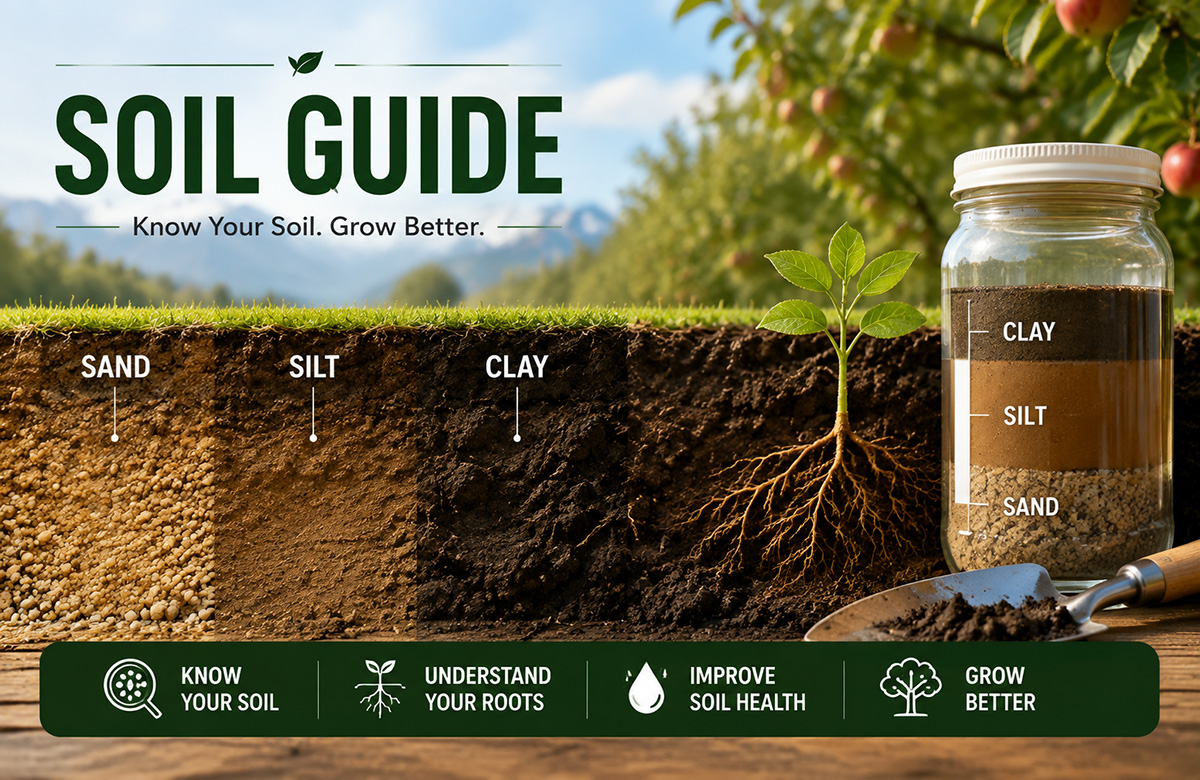
Before you feed your orchard, understand what it is growing in.
Soil is much more than the material that holds a tree upright. It is the environment in which roots find water, oxygen and nutrients, and its physical condition can determine how efficiently a tree can use all three.
Two orchards can receive the same fertilizer and irrigation and still perform very differently because their soils behave differently. One may drain quickly and require frequent irrigation, while another may hold water for too long and restrict root oxygen. A third may have a good balance of water and air but suffer from compaction.
For fruit growers, understanding soil begins with two basic ideas: soil texture and soil structure. Texture tells you what your soil is made of. Structure tells you how those particles are arranged and how water, air and roots move through the soil.
For temperate fruit orchards such as apple, pear and cherry, this understanding is particularly important. These crops need a sufficiently deep, well-aerated root zone with good drainage and adequate moisture-holding capacity. Poorly drained or compacted soil can restrict root development even when nutrients are present.
What is soil texture?
Soil texture refers to the relative proportion of three mineral particles: sand, silt and clay.
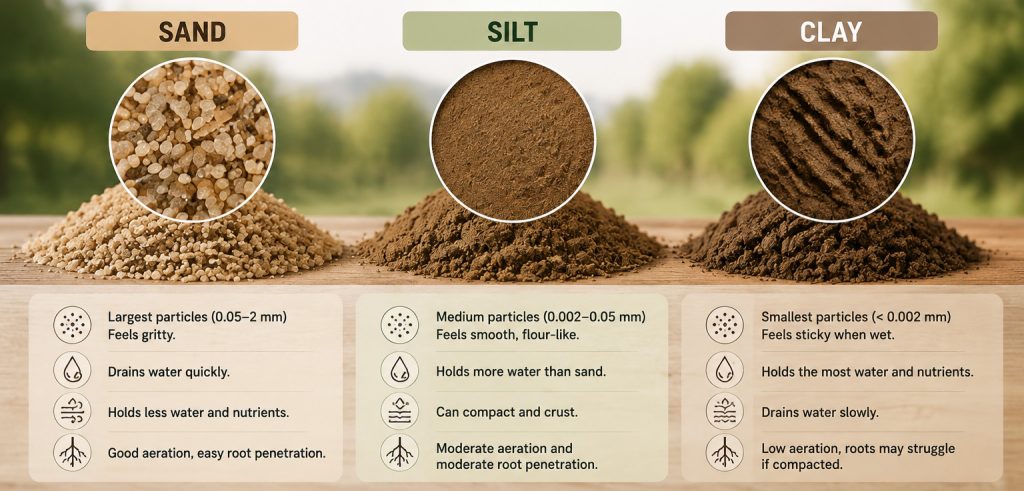
These particles are different in size, and that difference gives each soil its characteristic behaviour. Sand has the largest particles and creates relatively large pores through which water can move quickly. Clay has extremely small particles and a much greater surface area, allowing it to retain more water and nutrients, but soils with high clay content can also drain slowly and restrict air movement when poorly structured. Silt falls between the two.
Texture is one of the fundamental properties of soil because it influences water movement, available water-holding capacity, soil strength and natural fertility.
This is why knowing whether an orchard soil is sandy, silty, clayey or somewhere in between is not simply a matter of classification. It helps explain how that soil will behave under irrigation, rainfall, fertilizer application and root growth.
Sand, silt and clay: what do they mean?
Sandy soil
Sandy soil contains a relatively high proportion of large particles. It usually feels gritty when moist and does not hold together strongly.
Its biggest advantage is drainage. Water can move through sandy soil relatively quickly, and the large pores provide good aeration. The downside is that water and soluble nutrients can move beyond the active root zone more quickly. Sandy soils therefore often need more careful irrigation and nutrient management.
For an orchard, sandy soil is not necessarily a bad soil. Its challenge is usually retention, rather than drainage.
Silty soil
Silt particles are smaller than sand and generally feel smooth or flour-like when moist. Silty soils can hold more water than sandy soils and can be productive, but they may be vulnerable to compaction and erosion when poorly managed.
Clay soil
Clay contains very small particles with a high surface area. This gives clay soils a strong ability to retain water and nutrients.
The problem begins when high clay content is combined with poor structure or compaction. Water can infiltrate slowly, air movement can be restricted and the soil can become difficult to work when wet. Roots need oxygen as well as water, so a soil that remains saturated for long periods can become a serious limitation for fruit trees.
What is loam?
Loam is often described as the “ideal” soil, but the idea needs a little clarification.
Loam is a soil texture class with a favourable balance of sand, silt and clay. It is not simply a soil made from equal quantities of all three.
A well-balanced loam can provide a useful combination of water retention, drainage, aeration and nutrient-holding capacity. Sandy loam and silt loam can also be excellent agricultural soils when their structure, chemistry and drainage are suitable.
But there is an important point for orchard growers:
Loam does not automatically mean healthy soil.
A loamy soil can still be compacted, poorly drained, low in organic matter, saline or chemically unsuitable for a particular crop. Texture is only one part of the soil story.
Soil texture vs soil structure
These two terms are often used interchangeably, but they mean very different things.
Texture is what the soil is made of. Structure is how those particles are arranged.
Sand, silt and clay are mineral particles. In a healthy soil, these particles can bind together with organic matter, roots and biological activity to form aggregates. The spaces between and within these aggregates create pores through which water and oxygen move.
Good structure therefore creates a better balance between:
Water + Air + Root Space
A soil can have a heavy clay texture but still have reasonably good structure. Likewise, a sandy soil can have poor structure or very low organic matter.
This distinction is important because soil texture is difficult to change, while soil structure can be improved through management.
Why soil texture matters in a fruit orchard
Fruit trees are perennial crops. Unlike an annual crop, an apple or cherry tree may remain in the same soil for decades.
That makes the condition of the root zone particularly important.
Soil texture influences how quickly water enters the soil, how much water can be stored, how readily nutrients move and how much oxygen remains available to roots. In practical terms, this affects irrigation frequency, nutrient management, root development and the tree’s ability to tolerate periods of water stress.
A sandy orchard may need frequent irrigation because water moves through the profile rapidly. A heavy clay orchard may have the opposite problem: plenty of water, but insufficient drainage and oxygen.
The objective is not simply to have “more water”.
The root zone needs the right balance of water and air.
What kind of soil do apple trees need?
Apples generally perform best in deep, well-drained soils with good water-holding capacity and adequate aeration. Sandy loam, loam and silt loam can provide suitable conditions when their structure and chemistry are appropriate.
Drainage is particularly important. A soil that remains saturated can restrict oxygen around the roots, slow establishment and reduce tree vigour. Compacted layers below the surface can create the same problem even when the topsoil appears healthy.
This is especially important when establishing a new orchard. Before planting, it is worth looking beyond the top few inches of soil and understanding the entire potential root zone.
A beautiful topsoil layer cannot compensate for a compacted or poorly drained layer immediately underneath it.
What about cherries, pears and other temperate fruit?
The same principle applies across many temperate fruit crops.
Apple, pear and cherry trees generally benefit from a deep root zone that provides both moisture and oxygen. Excessive waterlogging is a common concern because prolonged saturation reduces the oxygen available to roots.
However, the exact soil preference and tolerance can vary with species, cultivar, rootstock, climate and management.
For this reason, there is no single sentence such as “this is the best soil for all fruit trees.”
Instead, growers should ask:
Does this soil provide the rootstock and crop with enough water, enough oxygen, sufficient rooting depth and an appropriate chemical environment?
That is a much more useful way to evaluate orchard soil.
How can you tell what type of soil you have?
You do not always need a laboratory to get your first indication of soil texture.
A simple field method is to take a moist sample and feel it between your fingers.
Sandy soil usually feels gritty and struggles to hold its shape. Silty soil feels smoother and more flour-like. Clay-rich soil tends to feel sticky and can be moulded into a more persistent shape or ribbon when sufficiently moist.
This feel method is useful for a quick field assessment, but it is still an estimate. For orchard planning and nutrient management, laboratory soil analysis provides a much more reliable picture.
The jar test: a simple way to estimate soil texture
One of the easiest ways to demonstrate soil texture is the soil jar test.
The principle is simple. When a well-dispersed soil sample is mixed with water and allowed to settle, the larger particles settle first, followed by progressively smaller particles.
The resulting layers can provide an approximate estimate of the proportions of sand, silt and clay.
This is particularly useful for growers who want a first understanding of their orchard soil before sending a sample for laboratory analysis.
Guide to go for jar test at home →
What you need
Take a representative soil sample, remove stones and roots, and place it in a transparent straight-sided jar. Add water, leave enough space for vigorous shaking, and use a suitable dispersing agent (little detergent) if available.
Shake the mixture thoroughly so that the soil particles separate. As the suspension settles, the heavier sand particles settle first, followed by silt and then the finest clay particles.
The exact settling times depend on the method used, so the jar test should be treated as an approximate field demonstration rather than a laboratory particle-size analysis.
From percentages to soil texture
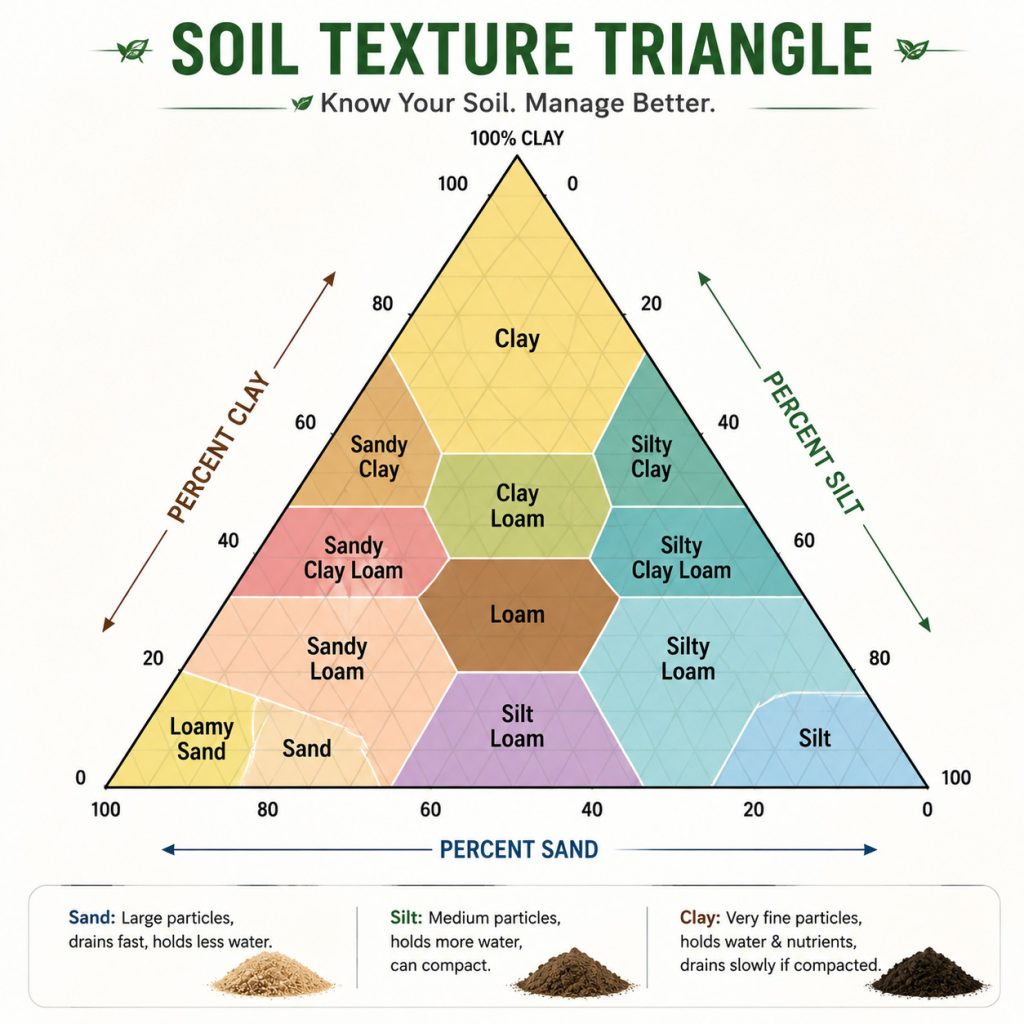
Once the relative amounts of sand, silt and clay have been estimated, they can be interpreted using a soil texture triangle.
For example, a sample with a high proportion of sand will fall toward the sandy side of the triangle, while a clay-dominant sample will fall toward the clay side. A balanced combination may fall within one of the loam classes.
The texture triangle is useful because it turns three percentages into a practical soil classification.
But remember: texture tells you the physical composition; it does not tell you whether the soil is fertile or healthy.
Two soils with the same texture can behave differently because their organic matter, structure, pH, salinity, compaction and biological activity are different.
What does your soil texture mean for your orchard?
Once you know your texture, the next question is more important:
What should you do with that information?
If your soil is sandy, the focus should generally be on improving water and nutrient retention. Organic matter, appropriate mulching and well-managed irrigation can help create a more favourable root environment. Sandy soils often require closer attention to irrigation because their available water reserve is lower and drainage is rapid.
If your soil is clay-rich, the focus is different. The priority is often maintaining aggregation, avoiding compaction and ensuring that excess water can leave the root zone. Clay soil should not be worked when excessively wet because traffic and cultivation under those conditions can damage its structure.
A loam or sandy loam soil may already have a favourable physical balance, but it still needs to be protected from compaction, erosion, organic matter decline and nutrient imbalance.
The goal is therefore not to make every orchard soil identical.
The goal is to manage each soil according to how it behaves.
How to improve soil structure
One of the most useful ways to improve soil structure is to increase and maintain organic matter.
Organic materials such as suitable compost, decomposed plant material and mulch provide carbon and energy for soil organisms and can contribute to better aggregation and water movement. Cover crops and living roots can also support soil biological activity and help protect the soil surface.
Avoiding unnecessary soil disturbance is equally important. Repeated tillage can break aggregates and contribute to loss of organic matter over time. Machinery traffic, particularly when soil is wet, can compact the soil and reduce the pore space available for air and water.
For an orchard, soil improvement is therefore less about adding one “magic” amendment and more about building a better root-zone environment over time.
Soil health is more than texture
Texture is only the beginning. A useful assessment of orchard soil should also consider pH, electrical conductivity, organic carbon or organic matter, nutrient availability, compaction, drainage and biological activity.
A sandy soil with excellent structure but very low nutrient retention requires a different management programme from a clay soil with high nutrient reserves but severe compaction.
This is why a soil test should be interpreted as a whole rather than as a list of individual numbers.
For orchard growers, the most useful question is not: “Is my nitrogen high?”
It is: “Is my root zone providing the conditions this tree needs, and what is limiting it right now?”
Soil testing before soil amendment
One of the easiest ways to waste money in an orchard is to add amendments without first understanding the problem. Before applying lime, gypsum, organic amendments or large quantities of nutrients, establish a baseline. A useful orchard soil assessment can include:
pH + EC + Organic Carbon + N + P + K + Ca + Mg + S + Micronutrients + Texture
The correct intervention depends on the actual limitation.
A high-pH soil should not be managed in the same way as an acidic soil. A saline soil should not be treated like a nutrient-deficient soil. A compacted soil should not be treated as if it simply needs more fertilizer.
Test first. Diagnose second. Amend third.
Final takeaway
You cannot choose the soil your orchard was planted in—but you can learn how to manage it.
Start with texture. Understand whether your soil is sandy, silty, clay-rich or somewhere within the loam range. Then look beyond texture to structure, drainage, compaction, organic matter, pH and nutrient status.
For temperate fruit trees, the ideal root zone is not simply “rich soil.” It is a soil that provides water, oxygen, nutrients and enough physical space for roots to grow.
A simple jar test can help you understand your soil texture. A soil laboratory can tell you much more about its chemical condition. Field observation can reveal compaction and drainage problems. Together, these tools turn soil from something growers simply work with into something they can actively manage.
Know your soil. Understand your roots. Grow better.
Frequently Asked Questions
What is soil texture?
Soil texture is the relative proportion of sand, silt and clay particles in a soil. It strongly influences water movement, water-holding capacity, aeration and nutrient behaviour.
What is the difference between soil texture and soil structure?
Texture describes the mineral particle sizes and their relative proportions. Structure describes how those particles form aggregates and pores. Texture is difficult to change, while structure can be improved through management.
How can I identify my soil type?
You can make an initial assessment using the hand-feel method or a jar test. For accurate classification, especially before establishing or managing a commercial orchard, use laboratory soil analysis.
What is the soil jar test?
It is a simple field method in which dispersed soil is mixed with water and allowed to settle. Sand, silt and clay settle at different rates, allowing their relative proportions to be estimated.
What is the best soil for apple trees?
Apples generally perform well in deep, well-drained soils such as suitable loams, sandy loams and silt loams. Good drainage and adequate root-zone depth are particularly important.
Can apple trees grow in clay soil?
Yes, but heavily clayey or compacted soils can create drainage and aeration problems. Management should focus on structure, drainage and avoiding compaction rather than trying to completely change the soil’s texture.
Can you change soil texture?
Not easily. The mineral texture of an established soil is largely determined by its sand, silt and clay content. Management can, however, improve structure, aggregation, infiltration, aeration and water retention.
How do I improve sandy soil?
Focus on improving water and nutrient retention through appropriate organic matter management, mulching and irrigation practices. Nutrient applications may also need to be managed carefully to reduce leaching.
How do I improve clay soil?
Maintain organic matter and good aggregation, avoid working or driving on wet soil, reduce compaction and address genuine drainage problems. Adding amendments without understanding the cause of poor drainage is unlikely to solve the problem.
Is loam always the best soil?
Loam and related medium-textured soils can provide a favourable balance of water retention and drainage, but texture alone does not determine soil health. A loam can still suffer from compaction, poor drainage, unsuitable pH or nutrient problems.
Why is soil drainage important for fruit trees?
Roots require both water and oxygen. Poorly drained soils can remain saturated, reducing oxygen availability and restricting root function and tree establishment.
Should I test my soil before planting an orchard?
Yes. Soil testing before orchard establishment can identify chemical and physical limitations early, when correcting them is generally easier than after trees are established.
Soil texture is the first step — soil intelligence goes further
Understanding your soil texture helps you know how it behaves, but it does not tell you everything about the condition of your orchard’s root zone. For a complete picture, growers should go beyond texture and get their soil tested for parameters such as pH, EC, organic carbon and nutrient availability.
This is where Orchardly’s soil intelligence can help. By combining soil-test information with orchard-specific data and agronomic context, Orchardly helps growers move from simply knowing their soil to understanding what it means for their trees and management decisions.
Know your soil. Test it. Understand it. Manage it better.